
#19 Hailing the Ball
An account of a fierce and homely game

Tonight, Workington thrums. People are coming out of their homes: groups of teenagers, parents and kids, the old guard and the new. Each group sluices through the streets, knowing the way. We know it too. Through Wellington Square, down the steps by the Ritz Cinema, across the car park, to the trees which crowd the beck, to the footbridge. This is where it will begin.
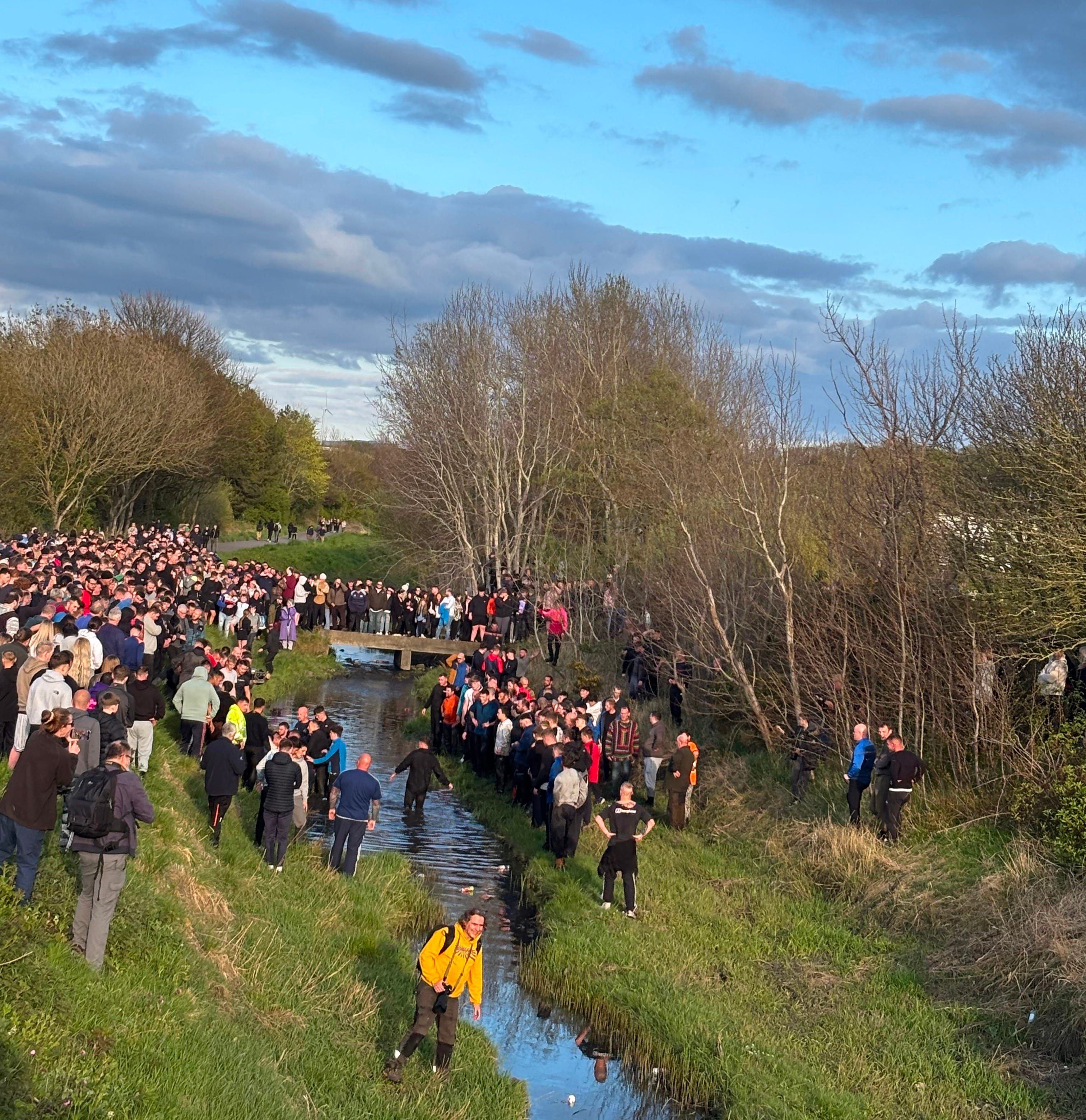
We fill in until both sides of the beck are full, until people are spilling out onto the footpaths, until children are scrambling up into the trees. In the car park, an ice cream van makes a killing, and fluorescent PCSOs cluster in pairs or fours with their hands tucked into their stab-proof vests. More and more people arrive. Some lads scatter down the grassy embankment, try to ford the beck to join friends, but the water runs knee deep and they back away. It’s not yet time.
At 19:00, the first glimpse of the ball, held by the child who will launch it. Brown leather, handmade. Each year, the same family puts three balls together: one for each of the games on Good Friday and the following Tuesday and Saturday. Each ball goes home with whoever hails it. For the Uppies (residents of east Workington, up the hill), they’re aiming for the gates of the old, dilapidated Workington Hall. For the Downies (residents of west Workington, down towards the sea), the goal is in the Prince of Wales docks. The hailer keeps the ball, might auction it for charity or might treasure it for life, part of an exclusive club. Not many can say they’ve won Uppies and Downies, our local game of no rules football.
It begins! Stood in the centre of the footbridge, the child slings the leather ball into the sky and then darts away shrieking. A wave of men breaks over the grassy bank, most onto the tight space of the bridge, others spilling into the muddy beck either side. Hands catch the ball and smuggle it down into the scrum, and now the game truly begins, out of sight, hands clawing within the dark press of bodies as the ball makes its mysterious journey from player to player, guided by force and fortune.
It’s the Saturday after Easter, the final game of 2025. The Uppies won Good Friday and Tuesday. Tonight is the last chance for the Downies to pull it back.
The crowd grows tightens around the bridge, peering into the tangle of elbows and shoulders, trying to glimpse the ball. Most of the game happens like this: long periods in a single place, the scrum unmoving, the ball passing back and forth between the same hands, progress quickly made and unmade. One strategy is to keep the ball still until dark comes and someone can make a run for it, ‘smuggling’ the ball away to one of the goals. But the sun is yet to set and dark is far away. And there’s movement, we can see, people slipping off the footbridge and into the knee deep mud-waters of the beck as a furrow passes through the crowd and -
The ball erupts into the air.
Now the whole crowd moves as one. The scrum untangles like a knot and men, some come straight from work and still in their hi-vis, barrage up the banks, over the foot path and into the flood meadow between the beck and the River Derwent. The crowd scatters out of the way: screaming teenagers leaping to the side, parents sweeping children up, friends running and laughing. As soon as the players are through, the crowd pours back in, lining the grassbanks which edge the flood meadow, sloping down towards the commotion. Children clatter out of the trees and tap across the footbridge, passing the muddy men left behind in the beck. K. and I are fast behind them, hurrying up the bank, back into the action.
As we come up to the flood meadow, we see a police car parked at the boundary with the road. On Tuesday, the action split over into the nearby Travel Lodge car park and a blue car’s bonnet was crushed as players tussled across it. That same ferocity is on display below. We see a placid crowd, with a thrumming, writhing heart. Bald heads, red faces, shoulders crashing. The ball moves like a magnet beneath the surface of the scrum, drawing bodies like iron filings into strange contortions.
The game stays here for fifteen or twenty minutes. There isn’t much to see. After the wild surge of movement, attention now fragments. The scrum at the centre is surrounded by people with cameras, people waiting to step in, but further out at the edges are mums with prams, and children doing TikTok dances, and teenagers snapping branches off trees, and a lad collecting the litter that such a gathering creates. At the edge of the commotion, not everyone is watching or able to see what’s going on, but it’s clear that it’s enough to be in orbit of the ball. That’s what draws people out, draws people together.
Uppies and Downies is necessarily a community run event. Announcements are made in a Facebook group, or circulated by word of mouth. The balls are handmade by the same family every year. Even the commentary is crowdsourced: a live feed of posts from different eyewitnesses, hosted by local news website. There are sponsors, who attach a cash prize or an offer of free breakfast to hailing, but it doesn’t seem for a second that this is anything other than peripheral to the game. We speak to one man who proudly recalls his son hailing the ball ten years ago. The recognition seems enough.
In the flood meadows, an upswelling. The surface of the scrum begins to bubble, heads bouncing, shoulders shuffling. The ball shoots up, is swallowed, shoots up again. After twenty minutes of quagmire, there is sudden propulsion across the flood meadow and up the green bank. The watchers lining the top of the bank spill down the other side as the scrum moves, a fritter of bodies running forward, backwards, sideways, scrambling for the ball: peaking and then crashing down the other side out of sight. As one, the crowd chases afterwards. It is early, and yet the ball is once again heading upwards.
Is this a shock? Uppies have, after all, won the last two nights as well as seven of the last ten overall seasons (discounting 2020 and 2021 where the pandemic put a halt to communal events). It’s the ingenuity and ferocity of the players that makes a victory, of course, but there are historical factors too. The working class neighbourhoods in which Downies traditionally lived was demolished in the 1980s, and now the town leans east. It’s been suggested in recent years that there is a dearth of Downie players, and some fear the competition might dry up entirely.
But not tonight. As we race up the grass bank, the ball appears momentarily in the sky and then plummets like a meteorite. We summit the bank and descend onto the footpath south of the beck, finding the scrum back in the water, metres from where it started, but leaning east towards the Uppie goal. K. and I scamper across the footbridge and brush through the child-swarmed trees. The sun is setting now and gold light glows like Bessemer fire. The bodies in the beck are blacked out silhouettes. Ragged breath begins to rise, hazy and desperate.
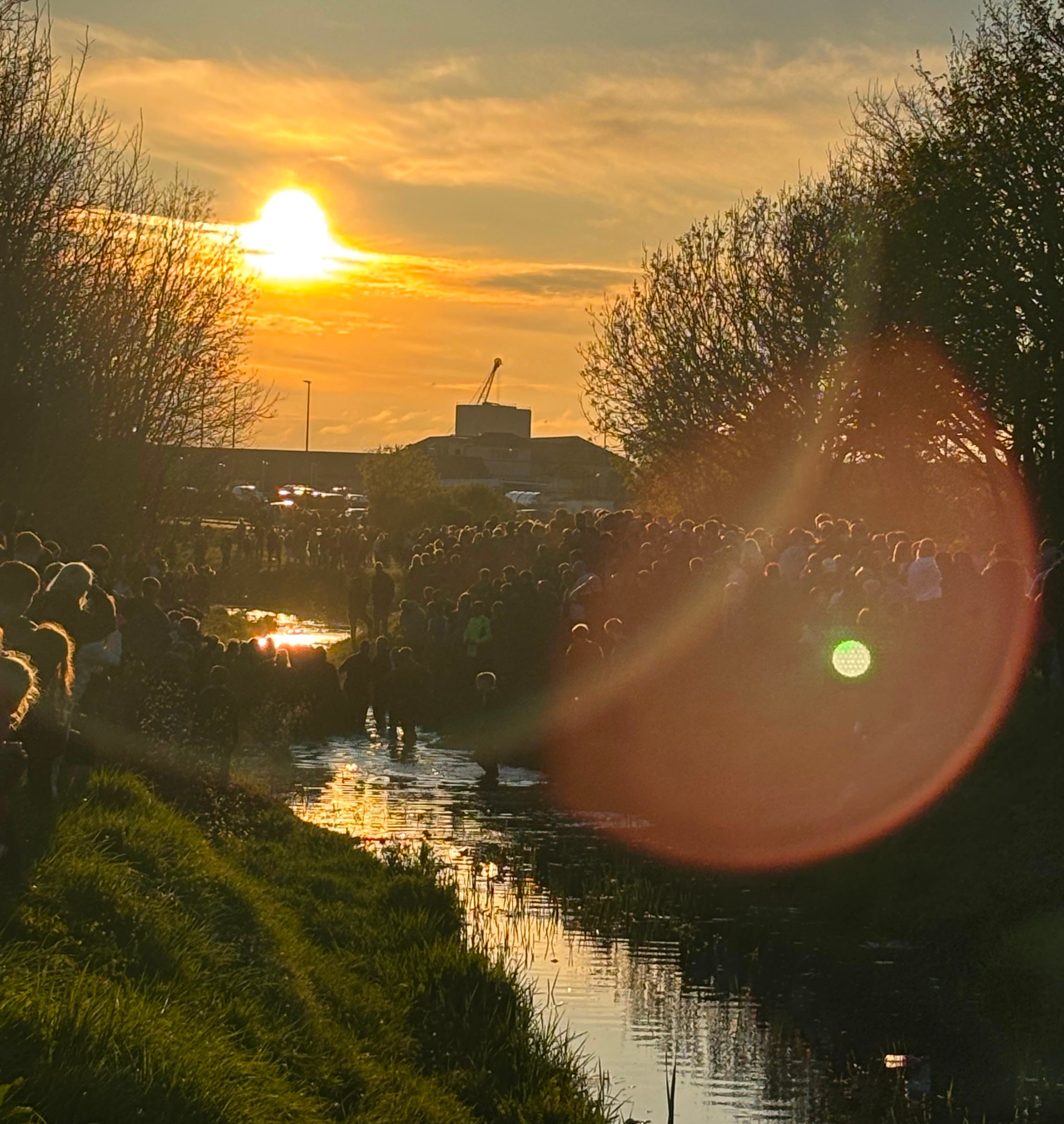
In the next thirty minutes, the game becomes a pinball machine. We see the ball scatter back and forth out of the beck, into the trees, and then back down again. The players are soaked through, water and mud running off them, and the crowds on either side of the commotion grow restless. We’re an hour in now, and it feels like the tenor of the game might change. Dark is approaching, and with it comes opportunity to smuggle.
As the beck wriggles with life, we meet the man whose son hailed the ball a decade ago. He speaks of the game with enthusiasm and familiarity: he’s been coming since childhood, used to take part and now watches. Every game is different, he tells us. Some stretch long into the night, into the bitter and confused early hours when most of the crowd have gone home. Others are rapid. The quickest he’s ever seen the game won was seven and a half minutes, an astonishing sprint by a Downie. There’s a sense of anticipation at every game: will this be one that might be talked about for years to come?
When he asks us if we’re local, I’m hesitant. I say at first that we live in Workington, and then slowly reveal we’re coming up to two years living here. This is the third game we’ve come to watch. I worry that we’ll seem like imposters, visitors, tourists come to spectate, rather than people interested in the things that make their town their town. It’s not an unfair stereotype that some people believe you have to live in West Cumbria thirty years before you’re welcome.
This time, my nerves are unfounded. The man seems pleased we’ve come along. He mentions the receding number of Downies. He tells us it’s good people that living here take interest, otherwise the whole thing will fade away.
A sudden roar. Whilst we’re chatting, the Uppies have made ground: the scrum has crossed the beck and has begun to mount an ascent of our side of the bank. Suddenly, one man breaks free of the rest and sprints. The whole crowd is pulled after him, as if drawn in the orbit of the ball. K. and I give chase. Dormant cars from the car park whirl into life, revealing themselves as unmarked police, scrambling to contain the flow. After stillness and deadlock, the movement is incredible: hundreds of people, bursting across the tarmac, vaulting fences, heading Up.
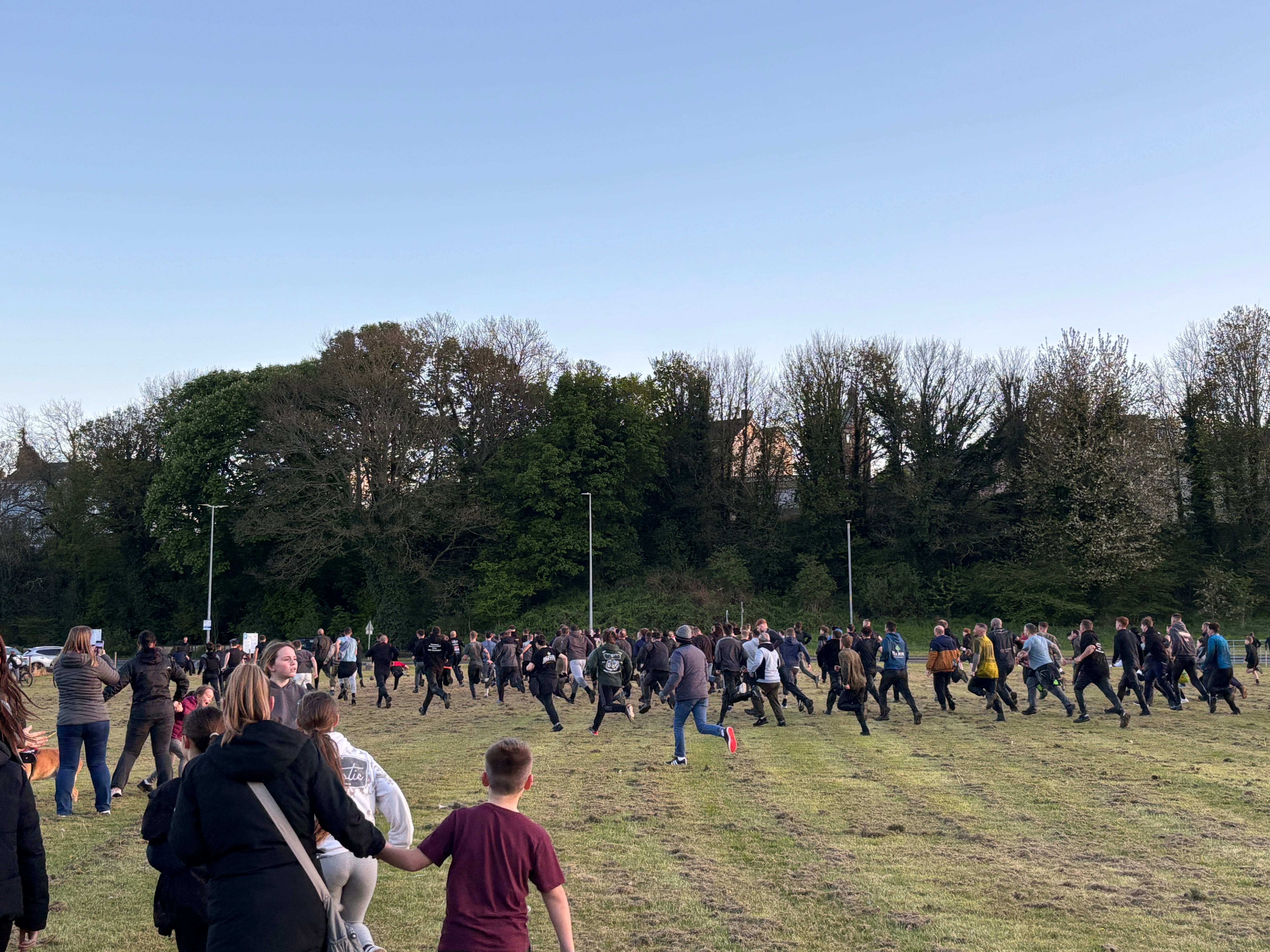
Where’s the ball? Eyes have been lost. There are men with mud up to their waists - exhausted, broken men - looking around, searching. But the rest of the crowd has momentum, surging up the stairs past the Ritz Cinema, funnelling down Ladies’ Walk. We don’t know the route the ball is taking but we know where it’s headed. The gates of old, dilapidated Workington Hall.
We cross the road by the courthouse and march in our hundreds up the steep slope. At the crumbling golden walls of the hall, beneath the cover of trees, there is electrical anticipation. People phone other members of the diffuse crowd, asking if they’ve seen it, what have they heard? The manor house - where Mary, Queen of Scots, once stayed, which has fallen derelict, overgrown and into ruin over the last century - looks on through anti-climb paint fences where windows once were. Where is the ball? Will tonight be the night?
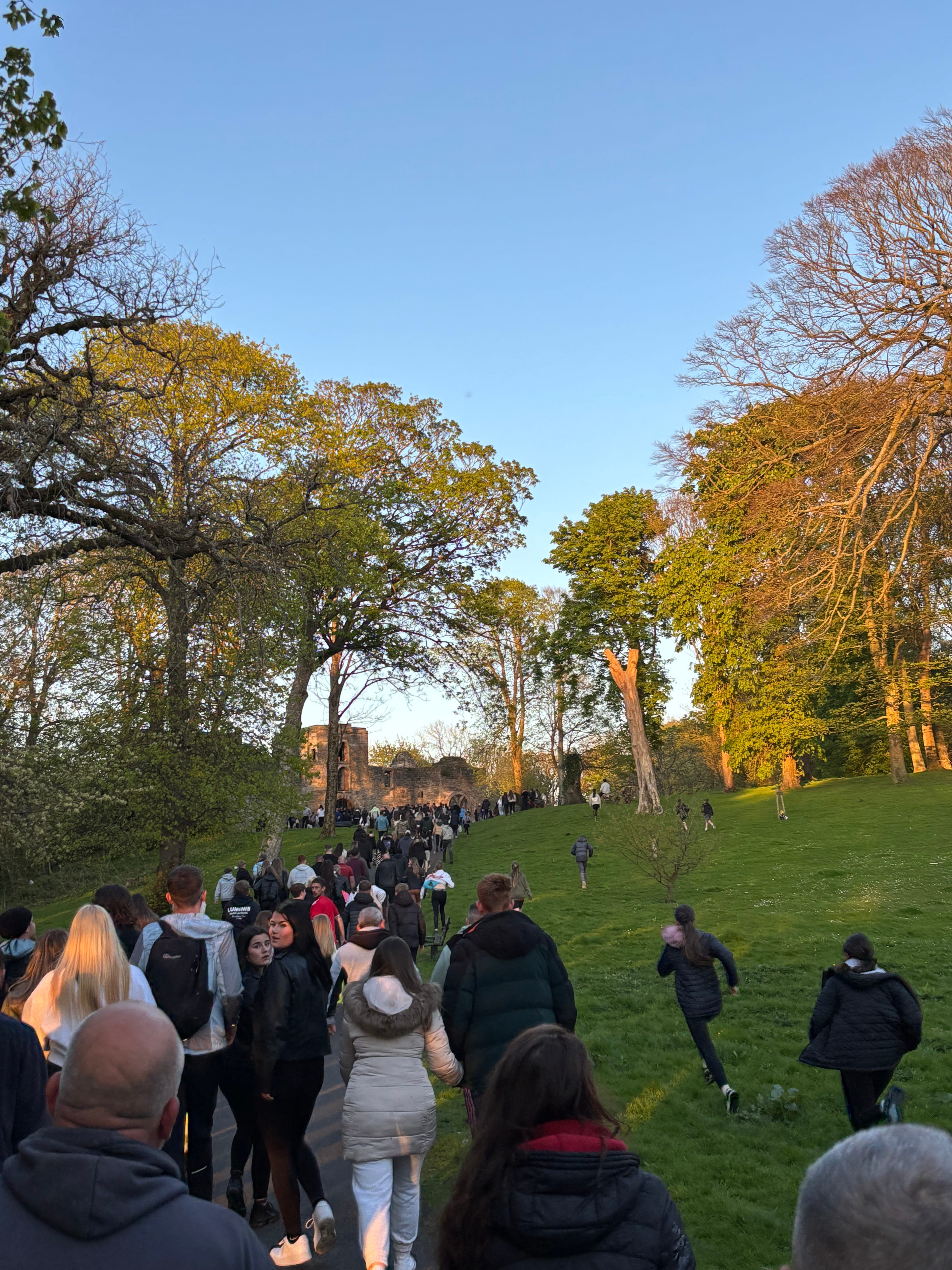
At 8:20pm, an hour and twenty after it began, a roar passes through the crowd and a man is lifted up onto shoulders to hail the ball. There is whooping and cheering. There is jubilation. An Uppie win, the third in the season and the confirmation of a clean sweep. It feels like we’ve just landed on the moon.
After long, the crowd begins to disperse, until the next year, until the next game. As we walk home from Workington Park, the hundreds thin and thin until it’s just me and K. walking down one side of the street, and another group of spectators on the other. They turn off one street before our own. I don’t know these neighbours: had never seen them before, and never seen them since. But we were both there tonight, watching Uppies and Downies in the town where we live, with our distinct memories of the same moment.
Uppies and Downies is a game of football where the teams don’t need coloured shirts. It’s also a no rules game with observed traditions, quirks, strategies, and specificities. You can know these things anywhere: in Lincoln, or Swansea, or - imagine this - Blackpool. But they only really mean something here, in Workington, where Uppies and Downies happens, with balls made by the same family every year, and a community who turn up for it. It couldn’t happen like this anywhere else.
This is a tradition rooted in a relationship between people and the place they live, that keeps going because they keep living there. This isn’t to say everyone in Workington is involved. Far from the whole town turns up, and I bet some residents even dislike the game. But for those who do see it, who embrace it, who turn up again and again for an event that can happen only here, there’s a clear sense of pride, and a clear sense of belonging.
This lets something strange happen. Because, although I’ve only lived here two years, I feel an inkling of pride too. I feel a smidge of belonging. I know the rules, the places. I’m beginning to learn the faces and the history. I was there on Easter Saturday 2025, when the ball was hailed in an astonishing hour and twenty minutes. I cheered with the crowd as the great feat was done, and I walked back through sunset with the fizzy feeling of a kind of magic that can only happen here. It will be a long time before anyone describes me as local, but I am a custodian of a small share of that night.
It’s a bit of local history I’ll always remember.
Like all good medieval traditions, the earliest records of Uppies and Downies are from the Victorian era. Here’s a great record of hailers back to Anthony Daglish’s Easter Tuesday hail for the Uppies in 1871.
This is the end of Belongs In A Museum, the local history series that’s been running over the last few weeks. I’ve really enjoyed writing about Georgian towns and twentieth century parades, about Roman inscriptions and medieval lynxes. I hope you’ve enjoyed reading too. The idea of ‘local’ has always been a tricky concept for me, a lad from a seaside town as constant as the tides. But I’ve enjoyed teasing out some of its complexities here, and exploring my sense of rootedness in the places and communities that have inspired these essays.
Limpet Away wil be away for a fortnight and then return with the final miniseries of Limpet Bay Year One. So, get hyped for Film Column, my first attempt at film criticism.
Brilliant description, Luke. It really swept me along. I have lived in Maryport for 36 years now. True locals still view me as an offcomer but in an affectionate way, I think!