
#5 Breakfast
Minnie Bruce Pratt on Bread and Embodied Experience

In the Grapes of Wrath, John Steinbeck’s ex-preacher Casey is asked to give a blessing. He stumbles through two pages of excuses and things he might say, and ends up on this: ‘I’m glad of the holiness of breakfast. I’m glad there’s love here. That’s all.’ And breakfast is holy, isn’t it? Put aside its nutritional value for a second. If you were a future anthropologist, what would you find? A ritual society is built around – a ritual that makes the day begin.
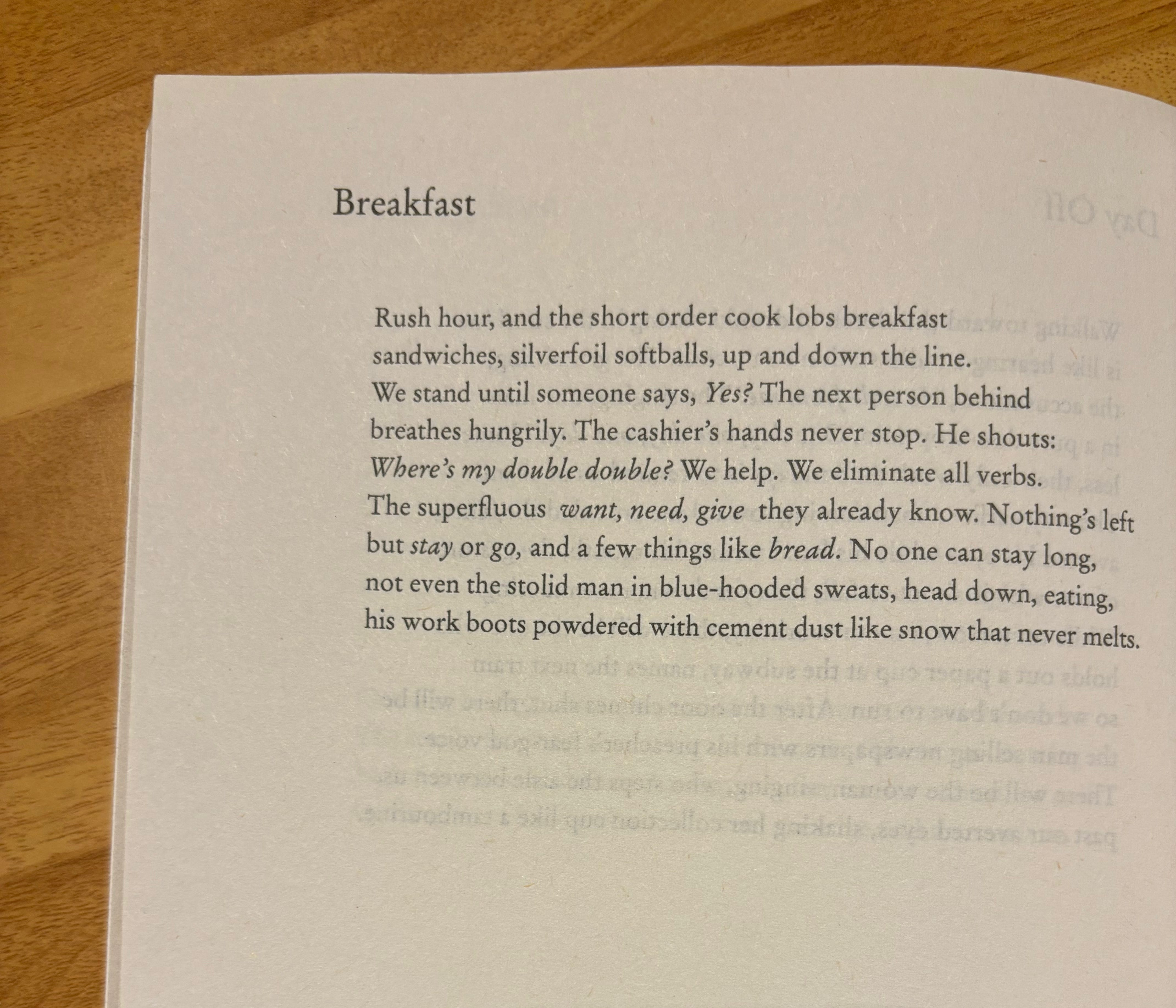
Minnie Bruce Pratt takes us to an American diner for breakfast here, and we can’t hang around. This poem is clipped and quick: ‘It’s Rush Hour’ is too slow, the poem jumps straight to the ‘rush’. Every line is a staccato fire of alliteration (‘short order cook lobs,’ ‘sandwiches, silverfoil softballs’) or short rapid repetitive sounds (‘double double’, ‘want, need, give’) so everything feels close and sudden. The boxy long lines make the page feel cramped, the lack of line breaks pushes us through. Like a queue, you’re in the poem, in the poem, in the poem, out!
But what a place to be. There is constant movement and overwhelming geography here – look at the directional language: ‘lobs’, ‘up and down,’ ‘behind.’ In lines 3 and 4, a profusion of short sentences tug our attention in every direction – us, someone speaking, the person behind, their breath, the cashier, his hands, his mouth. I feel like a ragdoll just reading it; my head aches with the din, my senses stir with the commotion. It’s all impossibly fast. It can’t possibly last.
And there unfolds the poem’s gorgeous contradiction. ‘Nothing lasts’ ends line 6, and line 7 adds ‘No one can stay long.’ And yet look at how familiar it all is. The customers know to ‘eliminate all verbs,’ and the staff ‘already know’ the want/need/give. They’ve done this before. This is a brief incandescent moment, one of urgency, one of haste. But it is, ultimately, breakfast. It happens every day.
As she describes the diner, Pratt discovers breakfast as a gathering. A time and a place, breakfast is when and where strangers come together in a common cause. Look at the pronouns ‘we’ and ‘us.’ The poem’s syntax is inviting you to understand the poet, and yourself, as part of something bigger. Breakfast isn’t just something we do, it’s something we do together. This makes the poem stand out. It’s one of the ‘new’ works in Pratt’s Selected and New Poems, a sequence preoccupied with the meeting of different languages, perspectives and cultures. In that context, ‘Breakfast’ feels out of place because it assumes a unity between the diner’s clientele. Communicating only in monosyllables, united in their need for morning food, their differences fall away.
Line 6 into 7 pulls these threads together: ‘Nothing’s left / but stay or go, and a few things like bread.’ The italics are Pratt’s own, and they present three facets of the human experience: staying, going, and bread. Staying is living, an ongoing act bookended by its ultimate non-sustainability. As the end of the line is keen to remind us, ‘No can stay for long’. Equally, going is dying, the event that ends your stay, presented in a simple dichotomy. But Pratt offers us a third option: bread. This is eating, sustaining, nourishment and the embodied fact of being. Days come and go, time rattles by, and yet we keep grabbing breakfast.
In this moment of sudden awareness, Pratt leans in. She tunes out the din and the caucus, she ignores the orders and the queue. Her attention hones in on a single customer, ‘a stolid man in blue-hooded sweats’ whose work boots are ‘powdered with cement dust like snow that never melts.’ This is the longest sentence in the poem, an astonishing 28 words vs the second longest at 17. The effect is a sense of lingering, a moment refusing to melt.
I think it’s easy to get lost in your own unfortunate mortality – I know it is for me – but perhaps it’s worse to dream of immortality, to pretend you’ll never eventually go. Pratt doesn’t do that here; the words ‘snow that never melts’ are final, ended with a full stop. Instead she offers us something else: a man ignoring an image of immortality, ‘head down, eating.’ If bread is real living, distinct from staying or going, it’s a moment of complete embodiment where it becomes impossible to imagine a past or a future. No death. No ongoing struggle of life. There is nothing else: only breakfast, and the wonder of being alive to eat it.
Well, I say there’s nothing else. The man in the blue-hooded sweat shares his moment with the poet, and with us, and with a busy room of strangers, all sharing in a communion of bread. A temporary communion. This exact combination of strangers will likely never again collide, even if they continue to eat a morning meal every day of their lives. Breakfast, for a few precious moments each day, is everything to everyone, and then it’s gone.
And isn’t that always the case? Isn’t life a series of these gatherings and these coming aparts? Isn’t life lived in the moments between the two, with the people we inhabit these moments with? The poem makes me think of all the wonderful people I’ve shared breakfast with. My partner, my parents, my grandparents, friends on May morning, chaplains and candlelighters after Passiontide Matins, fellow hikers up on misty hillsides, anonymous strangers in cafes and service stations, and my many selves making porridge or toast or cereal beneath a pink dawn sky: all of us quiet after sleep and happy to have woken, all of us sharing the company of a new day. How many of them will I see again? How many will I not? Either way: what a place. What a time. What a life. I’m glad of the holiness of breakfast. I’m glad there’s love here.
That’s all.
Next time: drawing back the green velvet curtain…
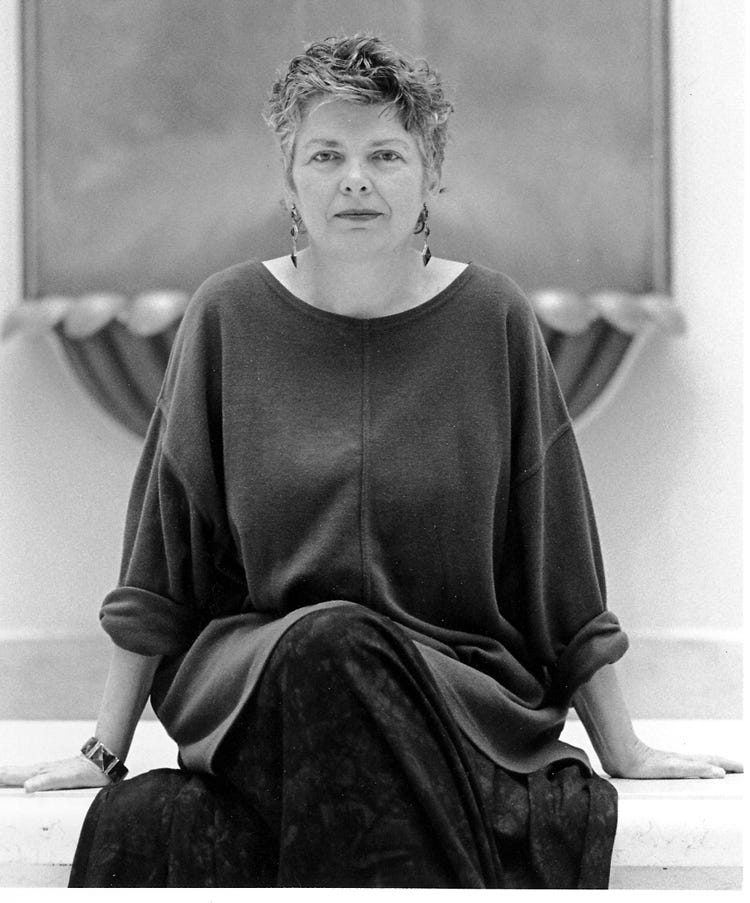
The notorious MBP was my poet of the month this April. Her work burns with righteous outrage and a strong eye for passion, justice and the intricacies of life. If you liked this, go read Temporary Job and Sharing the Eye
I was also amazed to learn she was married to Leslie Feinberg, who wrote Stone Butch Blues. The world pulls a little closer together…
Oh, and talking of pulling the world closer together, thank you so much for reading. This is officially the last essay of Limpet Bay Miniseries 1: Space Time Machine. When I started writing the Norman Nicholson essay earlier this year, I had no idea what I would do with it. I’m so grateful to everyone who has read, commented and shared these posts - knowing that my words are out there in other people’s heads is good, but hearing other people’s words in return, the gorgeous, generous things people share, is even better.
Next week: a bonus post in honour of a friend who asked me to explain my process (gulp). Then on with Miniseries 2: Unnature Writing.