
The Mountain Melts
On Helvellyn in the Snow

Thanks for reading Limpet Bay, a newsletter about how texts make worlds. Next time: archaeology and algorithms as we explore the ruins of the Legend of Zelda.
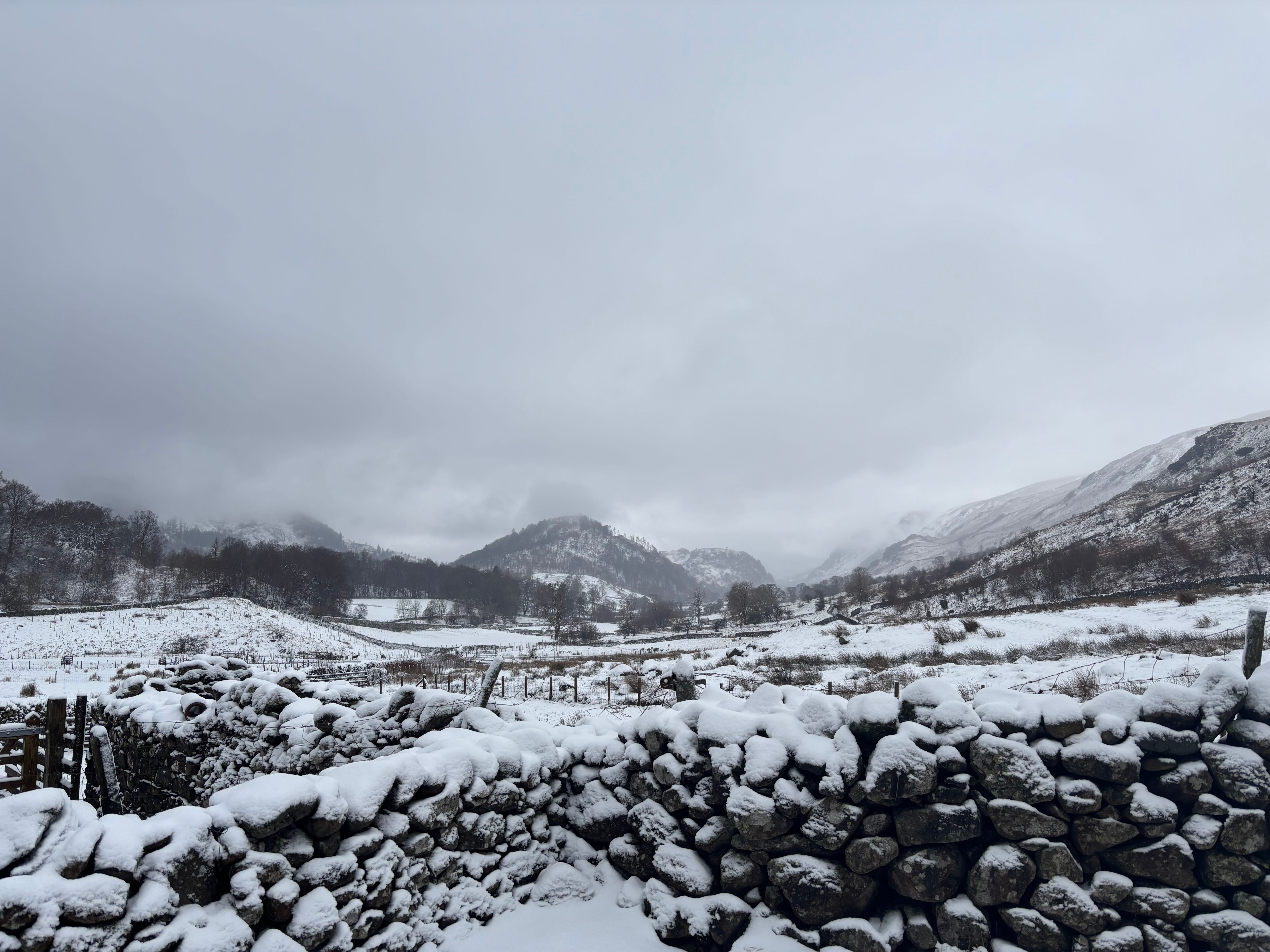
Soft quiet. Sound is absorbed by the fields of white that surround us, and extend their dominion up from the grass and over the cobbles of the dry stone walls. The trees are heavy with snow, and in places, icicles hang from branches. I am wearing five layers and we have all strapped spikes to the undersides of our boots. We leave claw marks in the snow behind us, as we make our way to the foot of the mountain.
We gain height rapidly, picking our way through the unspoilt drifts. Soaked, black rocks emerge from the white and serve as our only way markers. Coming up above the snowy trees, we see mist approaching from the south. It is leisurely as it creeps up the valley and smothers all beneath it. By the time it reaches the base of Helvellyn, we will be high above it, looking down onto cloud.
Water surprises me on the ascent. Thirlmere shrinks below, a white black-blue rink that has resisted freezing, has not been consumed by the same white as everything else. For the first leg of the journey, our path twists away from and back towards a ghyll and here too, we see the imperviousness to frost. No snow in the ghyll, but tumbling, foamy impressions.
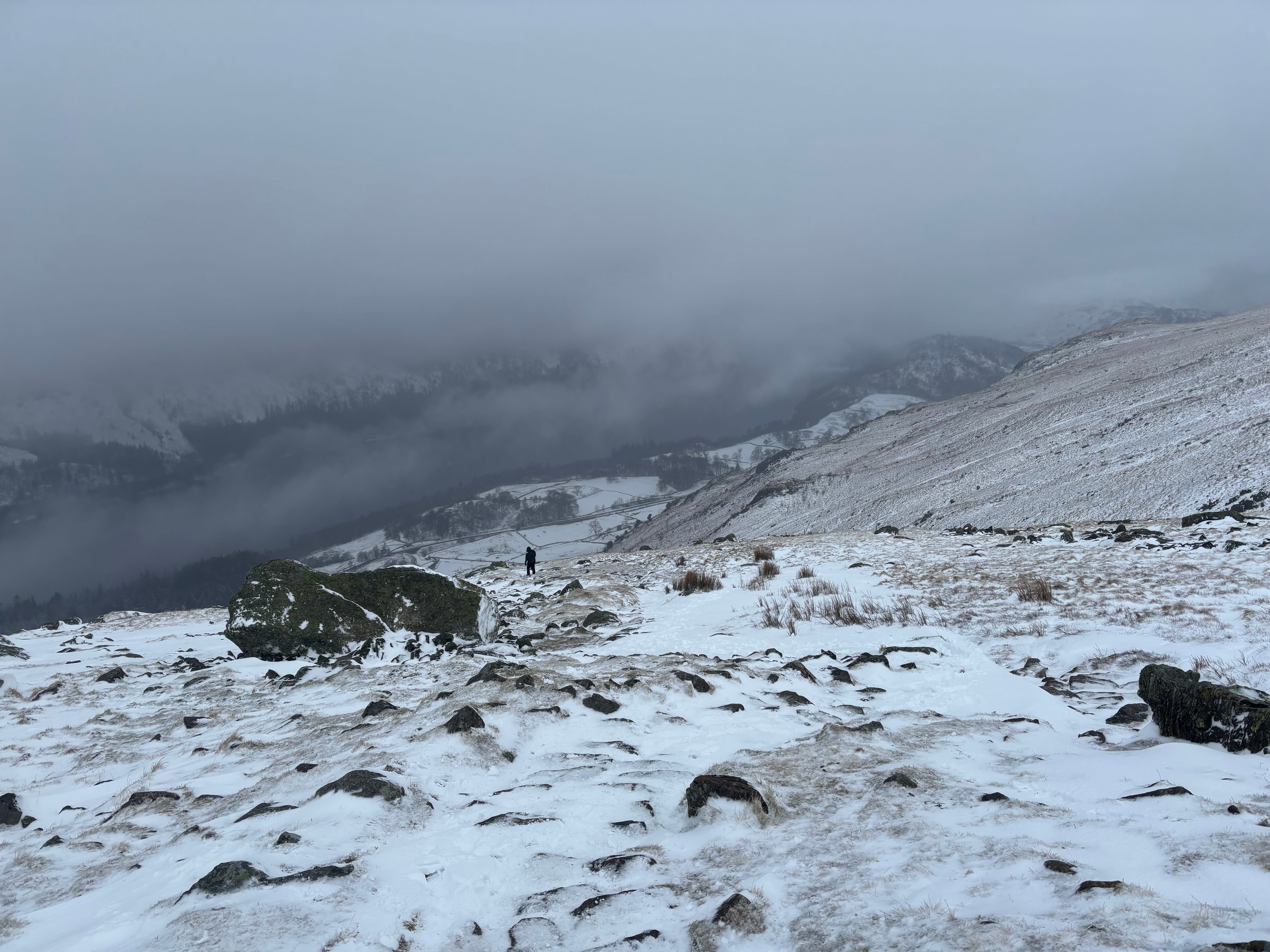
After half an hour, we pass the crumbled remains of an old shepherds’ hut and the climb intensifies. We kick shelves into the snow and drive our feet into the makeshift steps. My pole fishes beneath the surface, occasionally bashing drowned boulders, or returning with impossible sods. Grass, now, is unthinkable. The mountain’s skin is snow.
From the mist above, another party appears. They tell us they’ve had to turn back. Up on the top, there’s a banshee-wind ripping up ice and slinging it at them like lead bullets. We talk for as long as any of us can bear to stand still, and then they head down. Our little group discusses and decides to press on. It won’t be unsafe up above, just uncomfortable.
Higher now, we see the wind has scoured its fingers through the snow. Strange spirals and crescents ripple through the powder. As we walk, the patterns reset. Foot hollows crumble and fill in. The landscape is changing as we move through it.
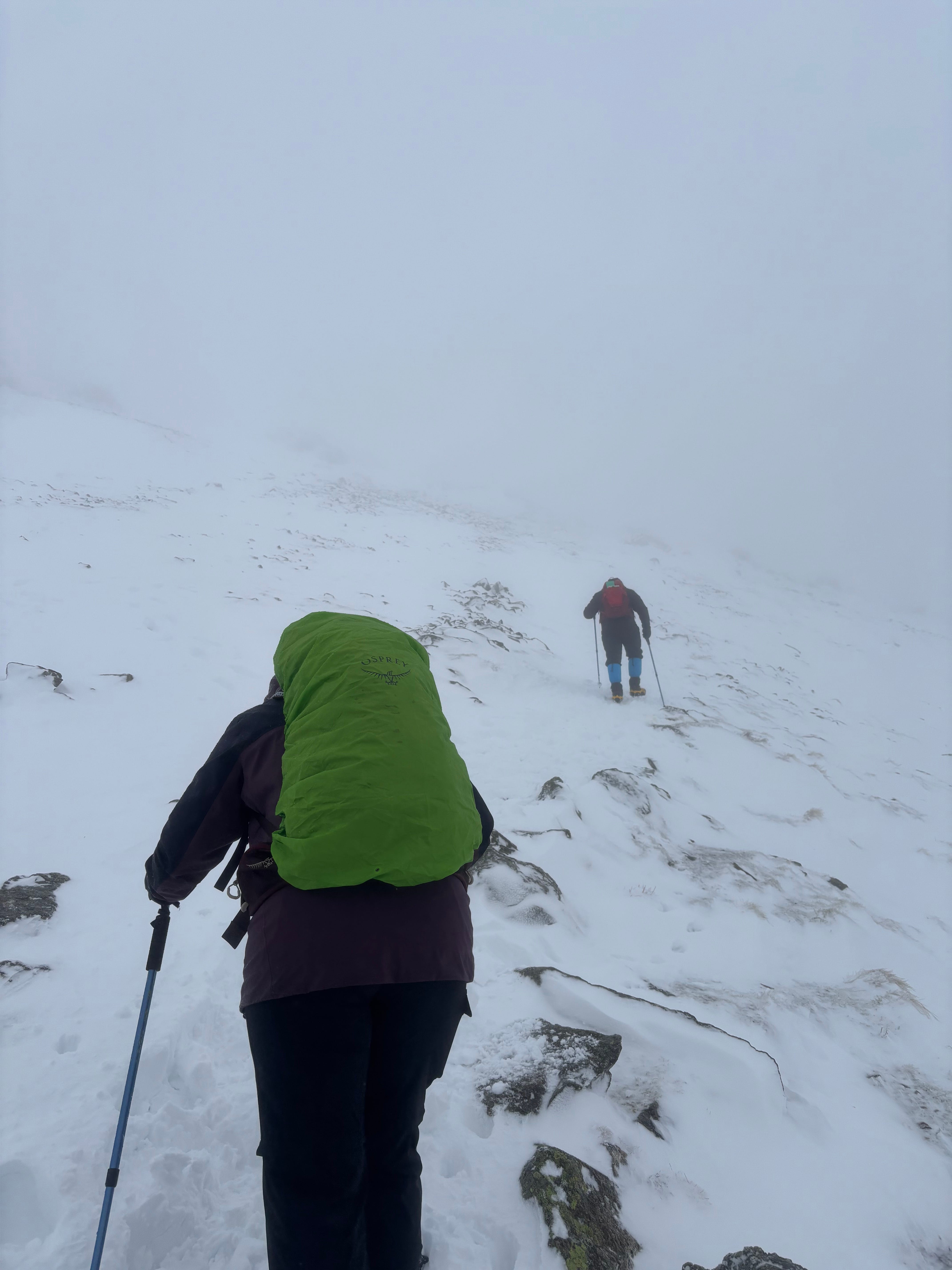
A near vertical patch brings us to a twist between towering boulders, and then out onto the plateau. The wind hits us. We stagger through the whiteness. My nose runs. Each step is a struggle. Soon the gateway boulders are invisible behind. A cairn occasionally emerges from the bright gloom ahead. Otherwise we cluster together, struggling on. All the time, the sky wheezes, wheezes.
I look down at my raincoat and see a rime of frost has formed over my buttons and pockets, trapping them beneath a sheet of ice. My hair, where it slips free of my hat, has frozen too. I have experienced dewberries before, where clouds make little temperate rainforests in the moss of my beard. But never before have I frozen on a walk, felt the material of my gloves harden, seen ice form on my person. We press on through the white.
We walk for an hour or for a day. There are no footprints up here, though we know others have been this way. The rest of the mountain range is a rumour: only the ground and the white exists around us. The sky could be as low as a nightclub roof for all it mattered.
I hear a rattling at my back and walking becomes harder. The wind has snatched the waterproof cover off my bag, and now it flares out behind me like a parachute, anchoring me with drag. My three companions huddle around me, our bodies united as wind shelters, as warmth-givers, whilst one of them tries to pack the cover away with clumsy, frozen fingers. No sooner is it done than another cover rips off another bag. We deal with that, but all of us are impatient to get moving again, growing irritable over something reasonable, something out of our control. The mountain is wearying us. It is not unsafe, just uncomfortable.
We reach the trig point. There is no sense this is a summit. No view, no conscienceable culmination. A wind shelter is somewhere nearby, but we cannot see it. We pause long enough for a photograph, and then we turn and march back. There will be other days for triumph on mountain tops. Today, the task is the journey back down.
One more trial. As we descend, my eyes begin to speckle with white luminous floaters. They are little shimmering ice crystals and I struggle to tell them apart from the snowflakes actually falling around us. My perception blurs. The mountain is in my eyes.
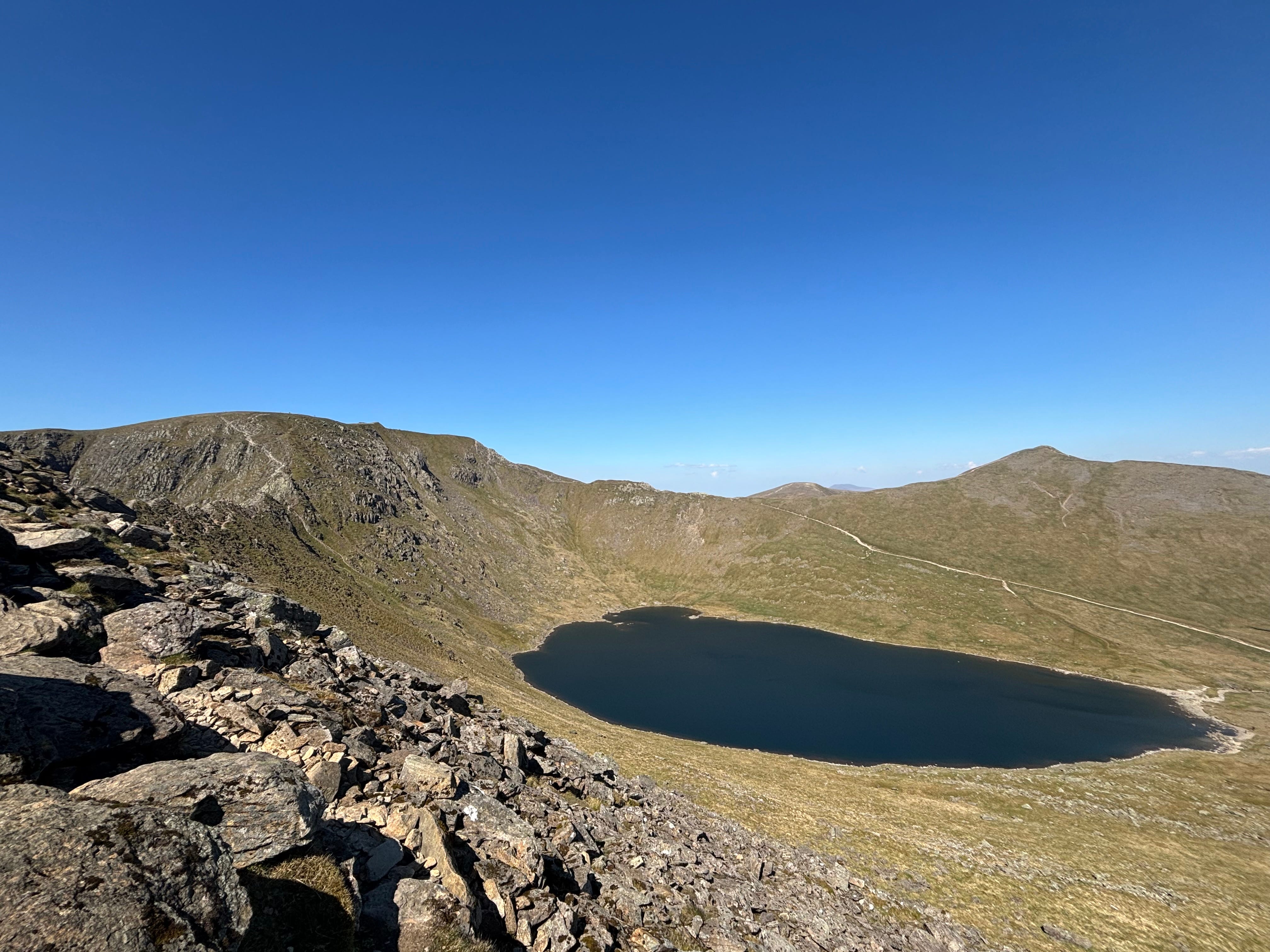
As we descend, I remembered my last ascent of Helvellyn. It was a busy weekend in May: wide blue skies, a hot sun, green and yellow grass for as far as the eye could see. We followed the golden strip of a footpath up from Glenridding, two in a hoard of daytrippers, making the most of a perfect day. We’d refilled our bottles from the stream as we’d descended. Our sweat had sizzled on our bare skin.
In the snow, we pass between the two guardian boulders and out of the wind. A moment’s celebration, and then the descent down the vertical patch. We kick shelves and half-climb, half-surf the collapsing frost bank. Snowflakes fall around us as we pass down into the mist.
We reach the spot where the other party turned back. We see more groups coming up. Some are ill-dressed for what awaits them and we pass on our experience. I go to gesture at my raincoat, but the rime has disappeared. My hair falls in front of my eyes. I am thawing. My buttons are, once again, my own.
Further down, the path is clearer. Rocks have surfaced through the snow, like a shale beach at low tide. We pick our way over the ice, guided by landing strips of emerging stone. Snowflakes land on the rock, white, fade to translucent ghosts, and then disappear altogether.
The mist clears and we catch sight of Thirlmere, vast, black-blue, repudiating the frost. Its efforts have spread. The valley is darkening. Soaked grass and rock cleave through the white, and the scuffle-marks of foottracks tear up what had once been a pristine coating. Walkers hike up towards us, their faces bleary against the rain. Yes, rain. We have passed some invisible boundary, so now the falling snowflakes thaw mid air, and plummet to the ground wet and miserable, tunneling into the remaining patches of ice.
We press on towards the reclaimed fields, through the ruins of the snow. Hardy ice continues to bind grass and stone together, but in places it has grown thin enough to crack at the press of a foot. Our spikes become cumbersome, either raking up clumps of muddied snow, or scratching on rocks. We decide to take them off and proceed as if on a normal walk. The few moments we stop to unclaw ourselves is long enough for the cold to set in: we are no longer frozen but soaked, and I begin to shiver beneath my five layers. We press back towards the cars, and see the ghyll has swollen. It cackles and snaps with the water rushing down it, washing away final snow drifts, bringing a wet-shimmer to the dirt.
Back at the base, we find the roads gritted and the trees green or bare. There is dirt in the world once more, and our wet legs are spattered brown with mud. Looking back up, the highest pinnacles of Helvellyn remain lost in white mist. But a ruinous streak is visible down its side: grey and brown and black, where the way has thawed, where the snow and its terrain have cleared.
So the mountain melts. I don’t doubt we will return to Helvellyn, but it will never again be the Helvellyn we climbed in the snow. That assemblage of frost and wind, snow and mist, has dispersed. Some other mountain stands there now, shuffling its cards, dealing a new climb every hour, chuckling at those who think it has ever stood still.
Here, one last gap of winter before Limpet Bay heads into the sun and green of Spring. Not mentioned: the way we shivered in the car all the way home, and how water managed to work its way through all five of my layers.
I think the party who turned back made the right decision to do so. Even if they were seasoned hikers, they felt uncomfortable and trusted their instinct to turn around. We only pressed on because three quarters of our group had done snow ascents of Helvellyn before, and because we had a GPS to navigate (rather than relying on a paper map that would have frozen). Definitely not one to try at home, though.
I love how transient mountains are, how much they change depending on weather and season and other matters of time. Compare this to your home, which is meant to be insulated against cold and lit against dark and roofed against rain and wind. But, of course, no building can ever be fully sealed off from the world. Is the presence of Nature to be found in the intrusion of time?